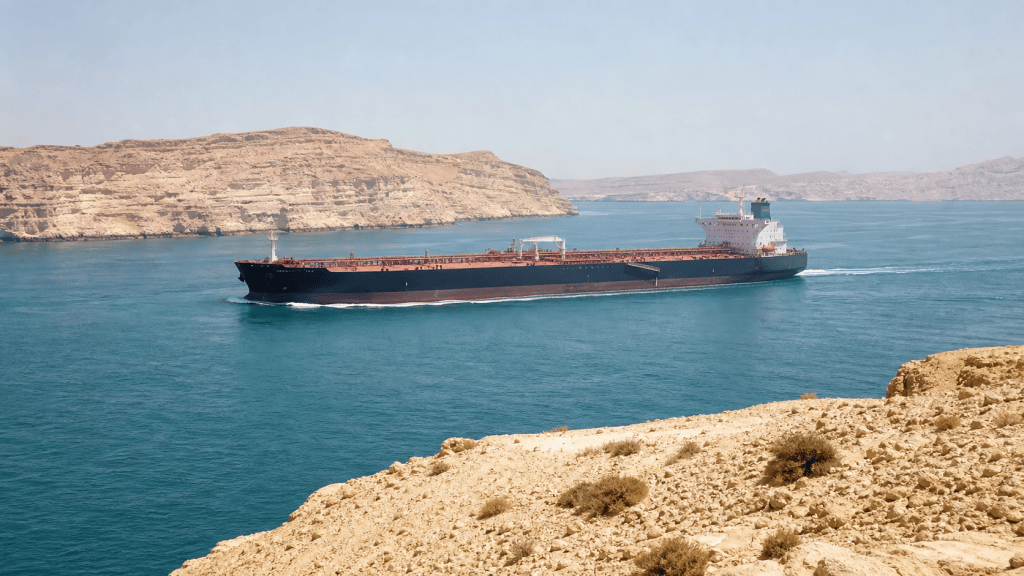
Tanker through dry waters
One tanker can move through the Strait of Hormuz without making Hormuz a normal trade route.
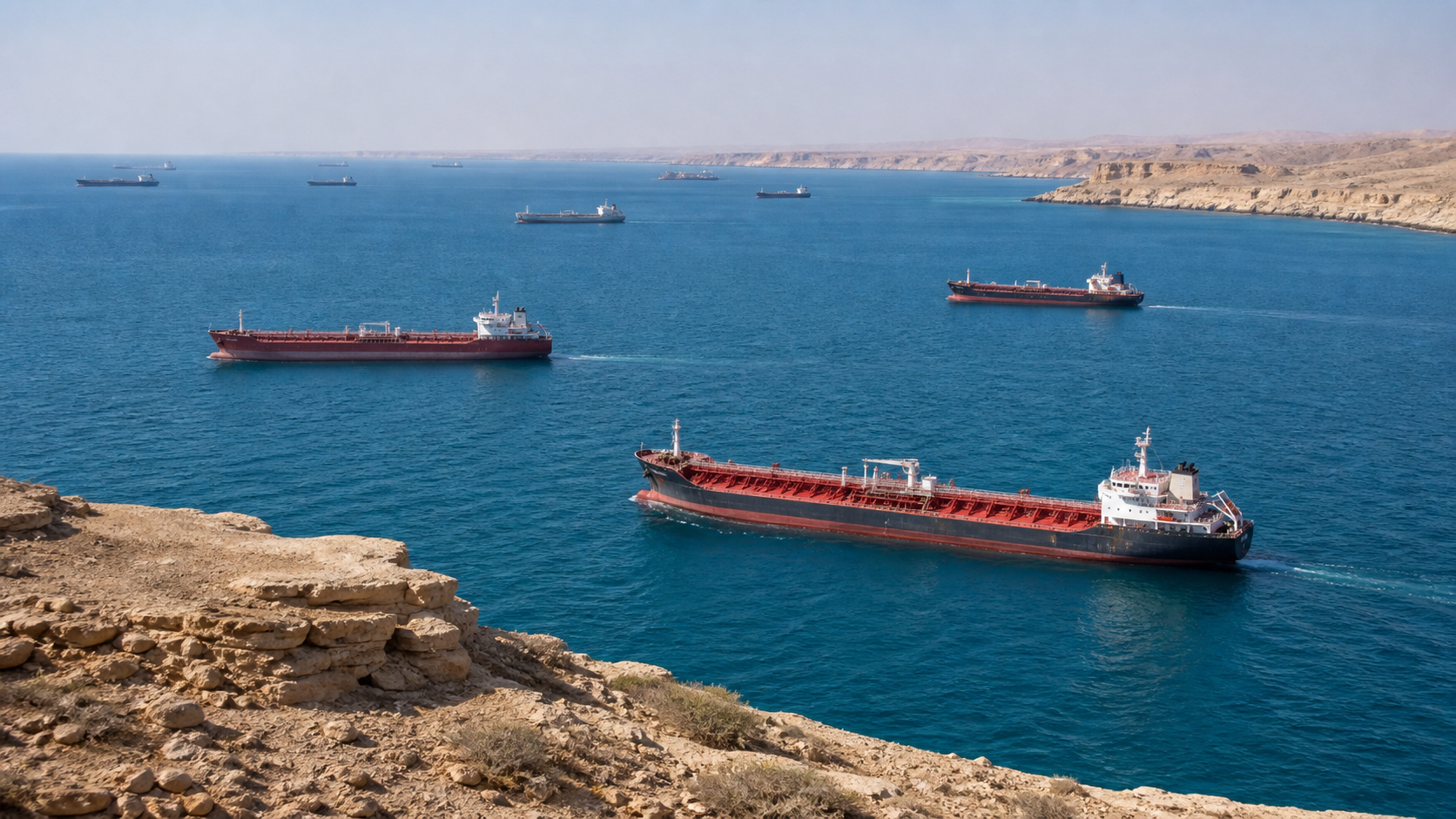
These are illustrative scenes, not photographs of documented current events.
That distinction matters because the current record shows a mixed system: ships are moving, but traffic remains reduced and the safety regime is still exceptional. Political claims about control have moved faster than evidence of normal commercial use.
ASSESSMENT: The public record supports saying that Hormuz remains physically available to some commercial traffic. It does not yet support saying that ordinary commercial navigation has recovered. A real recovery would require three things to appear together: sustained two-way passage, a lower and durable incident burden, and normal operator and insurance conditions. The first is visible in limited form. The full chain is not closed.
An open route can still be an exceptional system
On 14 August, Reuters reported competing claims from the United States and Iran over control of the strait. An Iranian official said Hormuz was under Iranian control and management. The United States said it could maintain a naval blockade of Iran indefinitely and increase economic pressure as ceasefire talks faltered. These are PARTY CLAIMS: they establish what the actors said, not what commercial operators can safely and repeatedly do.
An announcement cannot, by itself, make insurers price the risk normally, make charterers schedule confidently or make crews believe that a passage will remain safe after the next radio warning. The relevant result is not whether a government says that navigation is possible. It is whether the wider commercial system behaves as if ordinary navigation has returned.
The baseline: passage exists, normality does not
The latest traffic evidence is mixed but points in the same direction.
Reuters, using Kpler data, reported that commodity-vessel transits through Hormuz were still below the August daily average of 12. Nine vessels crossed on Thursday, 13 August: five entering the Gulf and four heading out toward the Gulf of Oman. That was an increase from five the day before, but it remained below the month’s average. The report also cautioned that ships with transponders switched off are not included in the count.
Lloyd’s List Intelligence provides a different but useful denominator. Its preliminary data recorded 78 cargo-vessel transits during 3–9 August, down from 95 the previous week. Non-Iranian-linked traffic fell from 63 to 45. The figures cover cargo-carrying vessels over 10,000 deadweight tonnes, so they cannot be combined mechanically with Reuters’ commodity-vessel count. They still show why one daily increase is not system-wide recovery.
The International Maritime Organization says its safe evacuation framework remains paused. Between 23 and 26 June, 136 vessels carrying 2,900 seafarers were evacuated through alternative routes. Approximately 6,000 seafarers remain in the region, while around 20,000 seafarers, port workers and offshore crews are affected.
The IMO’s current Hormuz page also lists a 3 August incident involving the Minoan Pioneer, in which one seafarer was reported missing. Earlier IMO reporting said the ordinary traffic separation scheme could not be used because of security risks, including the presence of sea mines, and that the safety of vessels and seafarers could not be assured.
Proof has three tests
1. Passage: are ships moving in both directions, repeatedly?
A usable commercial route should produce more than isolated voyages or a short-lived increase after a political signal. It should produce a sustained pattern that operators can plan around.
The current record shows movement in both directions, but not yet a stable recovery series. Reuters’ nine-vessel count is a one-day commodity-vessel observation; Lloyd’s List’s 78-transit figure covers a different cargo class over a week. Public numbers do not yet form one reconciled, all-vessel measure of normal traffic.
The strongest control would be a current series that states its denominator, separates inbound and outbound movement, and can be compared across multiple reporting periods. The series would need to show ordinary voyages rather than only exceptional or permission-based passages.
What would change the judgment: sustained two-way traffic across more than one reporting period, corroborated by a transparent technical or industry dataset. Falsifier: an independent current series showing that traffic has already returned to a stable pre-crisis pattern.
2. Safety: has the serious incident burden fallen and stayed down?
Commercial normality requires more than a route that remains legally or geographically available. It requires a threat environment in which crews are not repeatedly asked to choose between delay, rerouting and exposure to coercive action.
The official record remains cautionary. The IMO’s evacuation framework is paused because safe movement could not be assured. JMIC records threats, warning shots and explosions near transiting vessels. On 14 August, UKMTO listed three Strait of Hormuz attack entries: two tankers struck by UAVs with minor damage and a bulk carrier struck by an unknown projectile. Crews were reported safe; damage and environmental impact for the bulk carrier were unknown. These incident records do not establish attribution.
The U.S. Maritime Administration separately maintains a commercial-vessel advisory for the Gulf, Hormuz and Gulf of Oman. That is a risk control, not a traffic count. Together, the records show why “open” is not enough to answer the safety test.
What would change the judgment: a sustained period of materially lower serious incidents and coercive interference across maritime-security records, accompanied by ordinary operators returning. Falsifier: new attacks, reversals, serious warnings or emergency evacuations that keep ships from treating the route as routine.
3. Usability: are exceptional workarounds disappearing?
The final test is commercial. Can shipowners, insurers, charterers, terminals and crews use the corridor without extraordinary permissions, emergency routing or transfer-heavy substitutes?
The IMO says insurance costs in the region remain high. Allianz Commercial, an insurer and therefore an interested industry source, says marine cover remains available at increased premiums and that safe-passage assurances would be needed before traffic returned to pre-war levels. Its estimate of up to 140 vessels a day is context, not a current target independently verified here.
Lloyd’s List reports that merchant traffic continues via the Omani coast while volumes remain reduced, and that disruption is producing longer voyages, port congestion and rerouting. Earlier Reuters reporting also documented ship-to-ship transfers outside the strait as a way to keep some cargo moving while ordinary passage was impaired. Such workarounds can preserve part of the trade system. They do not prove that the normal system has returned.

What would change the judgment: normal insurance and scheduling decisions, stable direct voyages, usable route procedures and a clear decline in dependence on extraordinary transfers or permissions. Falsifier: continued reliance on special corridors, military-linked passages, emergency clearances or indirect transfers while officials describe the route as fully reopened.
What the public record can and cannot say
The available record supports saying that:
- commercial vessels are still passing through Hormuz;
- current traffic observations remain below recent or pre-crisis reference points, although the datasets use different denominators;
- the IMO’s emergency evacuation framework remains paused;
- serious maritime incidents and unresolved safety risks remain part of the official record;
- insurance and operating conditions remain abnormal enough that the route cannot be judged by physical passage alone.
It does not support saying that Hormuz is fully closed, that no ship can pass, that every incident is attributable to Iran, or that one successful voyage proves commercial recovery. It also does not support treating an insurer’s pre-war benchmark as a current traffic count.
LIMITATION: No single public source reconciles all-vessel traffic, incident rates, insurance pricing and operator decisions. Reuters and Lloyd’s List use different traffic denominators; IMO provides authoritative safety records, not a complete commercial-flow dataset.
UNRESOLVED: The current all-vessel traffic denominator, the final status of any political operating arrangement, the present level of serious incidents after the latest technical update, and whether insurance and chartering conditions are beginning to normalize remain unresolved.
Scenarios
Most likely
Confidence: medium. Time horizon: days to weeks. Hormuz remains technically available to selective commercial traffic while political claims and negotiations continue. The mechanism is the gap between public announcements and slower crew, insurer, charterer and terminal decisions. Indicators are uneven traffic, advisories, high-risk pricing and exceptional cargo channels. Falsifier: a transparent series shows stable two-way traffic, fewer serious incidents and ordinary operations.
Stabilisation
Confidence: low to medium. Time horizon: weeks to months. Relevant authorities establish credible safety guarantees, the recognised traffic scheme can be used safely, serious incidents fall and commercial actors return without extraordinary permissions. The mechanism is repeated compliance, not one announcement. Indicators are named procedures, stable direct voyages, lower insurance pressure and fewer emergency interventions. Falsifier: only special-corridor traffic improves.
Escalation
Confidence: medium. Time horizon: days to weeks. A new attack, threat, reversal or breakdown in political contact pushes operators toward avoidance and emergency workarounds. Risk reduces voyages; reduced voyages increase dependence on improvised arrangements, creating new coercive pressure. Indicators are reversals, damage, fresh advisories, stronger blockade measures or renewed evacuation disruption. Falsifier: sustained calm with normal commercial activity.
A 24-hour update
The freshest record does not overturn the judgment. Reuters’ current version, modified at 22:36 UTC on 14 August (00:36 CEST on 15 August), says Friday transit appeared near a standstill after two more ships were attacked. It remains incomplete and has no all-vessel denominator.
UKMTO’s official feed, read on 15 August, lists three 14 August incidents: two tanker UAV strikes with minor damage and a bulk carrier hit by an unknown projectile. Crews were reported safe; bulk-carrier damage and environmental impact were unknown. AP independently reports the tanker attacks and keeps UAE attribution to Iran as an allegation.
France 24’s 15 August report records fresh US and Iranian claims about control of the strait. Claims are not evidence of ordinary commercial operation. WHAT CHANGES: The new incident record strengthens the safety case that passage remains exceptional. It does not close the traffic or usability tests; the main judgment is unchanged.
WHAT THE EVIDENCE SHOWS: The reviewed public record shows continued passage and fresh risk, not demonstrated commercial normality. That conclusion is limited to the evidence identified above; it is not a claim that no other qualifying evidence exists.
Final judgment
The chain visible in the public record is straightforward: some vessels are moving; traffic measurements remain below recent or pre-crisis reference points; the official safety system is still operating in an emergency posture; serious incidents remain documented; and insurers and operators continue to face conditions that are not ordinary.
ASSESSMENT: “The route is being used” is supportable. “Shipping has recovered” is not. The missing fact is a current, independent record showing sustained two-way traffic under a lower-risk and ordinary commercial operating regime. Until that record exists, open is not the same as usable.
Sources
This analysis distinguishes institutional records, reported statements, industry context and assessment. The visuals are illustrative scenes, not documentary photographs of current events.
Reuters, “Hormuz traffic slows further after US threatens more economic pressure on Iran,” published 14 August 2026; modified 15 August 2026: source
UKMTO, Recent Incidents — attacks `#111`, `#112` and `#113`, 14 August 2026: source
Associated Press, “2 UAE tankers hit by drone attacks while transiting Strait of Hormuz,” 14 August 2026: source
France 24, “Middle East live: Trump threatens US takeover of Hormuz as Iran vows to retain control,” issued and modified 15 August 2026: source
Lloyd’s List Intelligence, “Strait of Hormuz Brief: 12 August 2026,” 12 August 2026: source
International Maritime Organization, Middle East — Strait of Hormuz and shipping/seafarer information: source
International Maritime Organization, Update to the Council (C 137), 8 July 2026: source
Allianz Commercial, Safety and Shipping Review 2026, 24 June 2026: source
UKMTO/JMIC, JMIC advisories 2026: source
U.S. Maritime Administration, MSCI 2026-004 — Persian Gulf, Strait of Hormuz and Gulf of Oman: source
Reuters, Strait of Hormuz transits, 17 July 2026: source
Reuters, Gulf of Oman transfer activity, 20 July 2026: source
 Measured Affairs